






Is Grain-Free Cat Food Good for Cats? Benefits, Risks & Who May Need It

Is grain-free cat food good for cats? For most healthy cats, grain-free food is not automatically healthier than a complete, balanced food that contains grains. Cats need specific nutrients, including animal-derived protein, taurine, essential fatty acids, vitamins and minerals. Grains can provide useful nutrients and digestible energy when included in a properly formulated diet.
At World of Birds in Souq Al Ali, Doha, we stock both grain-free and grain-inclusive cat foods for owners across Qatar. Our team has been serving pet owners in Doha since 1985, and our current cat-food range includes dry and wet formulas for different life stages and dietary needs.
The 2025 FEDIAF nutritional guidelines provide reference nutrient levels for complete and complementary cat foods in Europe. This highlights an important point: the nutritional adequacy of the complete formula matters more than whether the front of the package says “grain-free.”
This guide explains what grain-free means, when it may be useful, what it does not prove, and how our available products fit into the wider discussion.
Quick answer: Grain-free cat food can be suitable for cats, but most healthy cats do not need to avoid grains. A complete and balanced formula that matches the cat’s life stage and health needs matters more.
Key Takeaways
- Grain-free does not automatically mean healthier also does not mean carbohydrate-free.
- Cats can digest properly cooked grains used in complete diets.
- Grain allergies are possible but uncommon compared with several animal-protein allergies.
- Food allergies require proper dietary investigation rather than relying on a grain-free label.
- The nutritional adequacy statement is more useful than marketing claims alone.
- Our Qatar range includes both grain-free and low-grain cat-food options.
- Cats with medical conditions may need a veterinarian-guided diet.
What Is Grain-Free Cat Food?
Grain-free cat food is cat food made without cereal grains such as wheat, corn, rice, barley or oats. Removing grains does not mean removing carbohydrates. Manufacturers can use potatoes, peas, lentils, tapioca or other carbohydrate sources instead.
This distinction matters because some owners assume “grain-free” means a food contains only meat and animal ingredients.
It does not.
Grain-Free vs Low-Grain
These terms describe different formulas.
| Term | Meaning |
| Grain-free | No cereal grains are included |
| Low-grain | Grains are included at a reduced level |
| Gluten-free | Free from gluten-containing grains or gluten ingredients |
| High-protein | Higher protein content; unrelated to grain status |
| Low-carbohydrate | Lower carbohydrate content; not guaranteed by grain-free status |
A grain-free dry food may still contain substantial starch because dry kibble generally needs starch to form its structure.
Therefore, grain-free and low-carbohydrate are not interchangeable terms.
Is Grain-Free Cat Food Better?
Grain-free cat food is not automatically better for a healthy cat. Veterinary nutrition sources recommend focusing on complete nutrition, life stage, body condition, ingredient tolerance and the cat’s individual health needs rather than treating grain-free status as a quality guarantee.
Grains can provide protein, fibre, vitamins, minerals and digestible carbohydrates. Their presence does not automatically indicate poor-quality food.
What Matters More Than Grain-Free?
When we assess a cat-food option at World of Birds, the more useful questions include:
- Is it formulated for cats?
- Is it appropriate for the cat’s life stage?
- Is it complete and balanced?
- Does the manufacturer provide useful nutritional information?
- Does the cat tolerate the food?
- Is the portion appropriate for the cat’s body condition?
- Does the cat have a diagnosed condition requiring specific nutrition?
The World Small Animal Veterinary Association (WSAVA) also recommends looking beyond marketing terms and checking nutritional adequacy, manufacturer information, quality control and nutritional expertise.
Can Cats Eat Grains?
Yes, cats can eat properly formulated cat food containing grains. Grains such as rice, wheat, corn and oats can provide digestible nutrients and energy when used as part of a complete feline diet.
Cats are obligate carnivores, but this does not mean every plant-derived ingredient is unsuitable.
Why Are Grains Used in Cat Food?
Grains can contribute:
- Digestible carbohydrates
- Protein
- Fibre
- Vitamins
- Minerals
- Essential fatty acids
The important issue is the finished nutritional profile, not whether one ingredient sounds more natural than another.
A properly formulated grain-inclusive diet can meet a cat’s nutritional requirements. There is no established requirement for healthy cats to avoid grains.
For a broader look at everyday feline nutrition, our pet food guide for Qatar covers nutrition, food types and feeding considerations for local pet owners.
Does Grain-Free Help With Cat Allergies?
Grain-free food can be useful when a veterinarian has identified a specific grain as a dietary trigger, but grain allergies are relatively uncommon in cats. Several animal proteins, including beef, fish and chicken, are more commonly associated with feline food allergies.
A grain-free label therefore does not prove that a food is suitable for an allergic cat.
Food Allergy vs Food Intolerance
These terms are often confused. A food allergy involves an immune response to a food component, usually a protein.
And A food intolerance can cause digestive problems without involving the same immune mechanism.
VCA notes that cats with food allergies may develop chronic itching, skin inflammation, vomiting or diarrhoea. Proper diagnosis generally involves a controlled elimination diet followed by a food challenge.
If your cat has recurring vomiting, diarrhoea, itching or skin problems, a veterinarian should investigate the cause before you rely on a grain-free diet.
For more context, our cat food guide for sensitive stomachs in Qatar explains why digestive symptoms do not automatically mean your cat needs grain-free food.
What Are the Benefits of Grain-Free Cat Food?
The main potential benefit of grain-free cat food is that it removes specific grains from the diet, which can matter for an individual cat with a confirmed dietary reaction. For most healthy cats, however, there is no established general health advantage from removing grains.
When Grain-Free May Make Sense
A grain-free formula may have a role when:
- A veterinarian recommends avoiding a particular grain.
- A cat has a confirmed dietary reaction involving a grain.
- The cat tolerates a specific grain-free formula better.
- An owner may also have a clear dietary reason for selecting that formula.
Even in these situations, the complete formulation remains important.
What Grain-Free Does Not Guarantee
Grain-free does not automatically guarantee:
- Higher protein
- Lower carbohydrate
- Better digestion
- Fewer calories
- Better weight control, allergy protection & overall nutrition
A grain-free formula can replace grains with other starch-rich ingredients.
Are There Risks With Grain-Free Cat Food?
The main concern with grain-free cat food is not the absence of grains itself. Instead, the concern is assuming that grain-free automatically means nutritionally superior or medically necessary.
A poorly formulated diet can be unsuitable regardless of whether it contains grains.
Grain-Free and Heart Disease
The grain-free discussion is sometimes mixed with reports about diet-associated dilated cardiomyopathy, or DCM, in dogs.
PetMD’s veterinary review notes that the dog-related grain-free DCM concern does not establish the same relationship in cats. Feline DCM has a different nutritional history, including the established importance of taurine in feline diets.
The practical lesson is simple: do not judge a cat food’s safety from the grain-free label alone. Look at the full formulation and nutritional adequacy.
Does Not Mean Meat-Only
Some grain-free formulas replace wheat, corn or rice with:
- Peas
- Lentils
- Potatoes
- Sweet potatoes
- Tapioca
These ingredients can still contribute carbohydrates.Therefore, a cat owner interested in lower carbohydrate intake should not use “grain-free” as the only indicator.
How Should You Read a Grain-Free Cat Food Label?
Start with the nutritional adequacy statement, life-stage information and manufacturer details before focusing on whether grains appear in the ingredient list. WSAVA recommends checking whether a food is complete, appropriate for the animal’s life stage and supported by reliable manufacturer information.
Label Checklist
Check these points:
- Species: Confirm the food is formulated for cats.
- Life stage: Check whether it is for kittens, adults or another life stage.
- Nutritional adequacy: Look for a statement showing that the food provides complete nutrition.
- Protein sources: Review the named animal proteins.
- Calorie information: Use it when available to manage portions.
- Manufacturer details: Look for accessible company information.
- Feeding instructions: Adjust portions according to the cat’s needs.
- Health claims: Treat marketing claims as secondary to nutritional information.
FEDIAF’s 2025 Nutritional Guidelines provide reference nutrient levels used by the European pet-food industry when developing complete and complementary foods.
Grain-Free Cat Food Options in Qatar
World of Birds stocks grain-free and low-grain cat foods in Qatar, including products suited to different ages and feeding preferences. Availability can change, so product information should be checked before purchase.
AlphaPet Grain-Free Salmon Wet Food
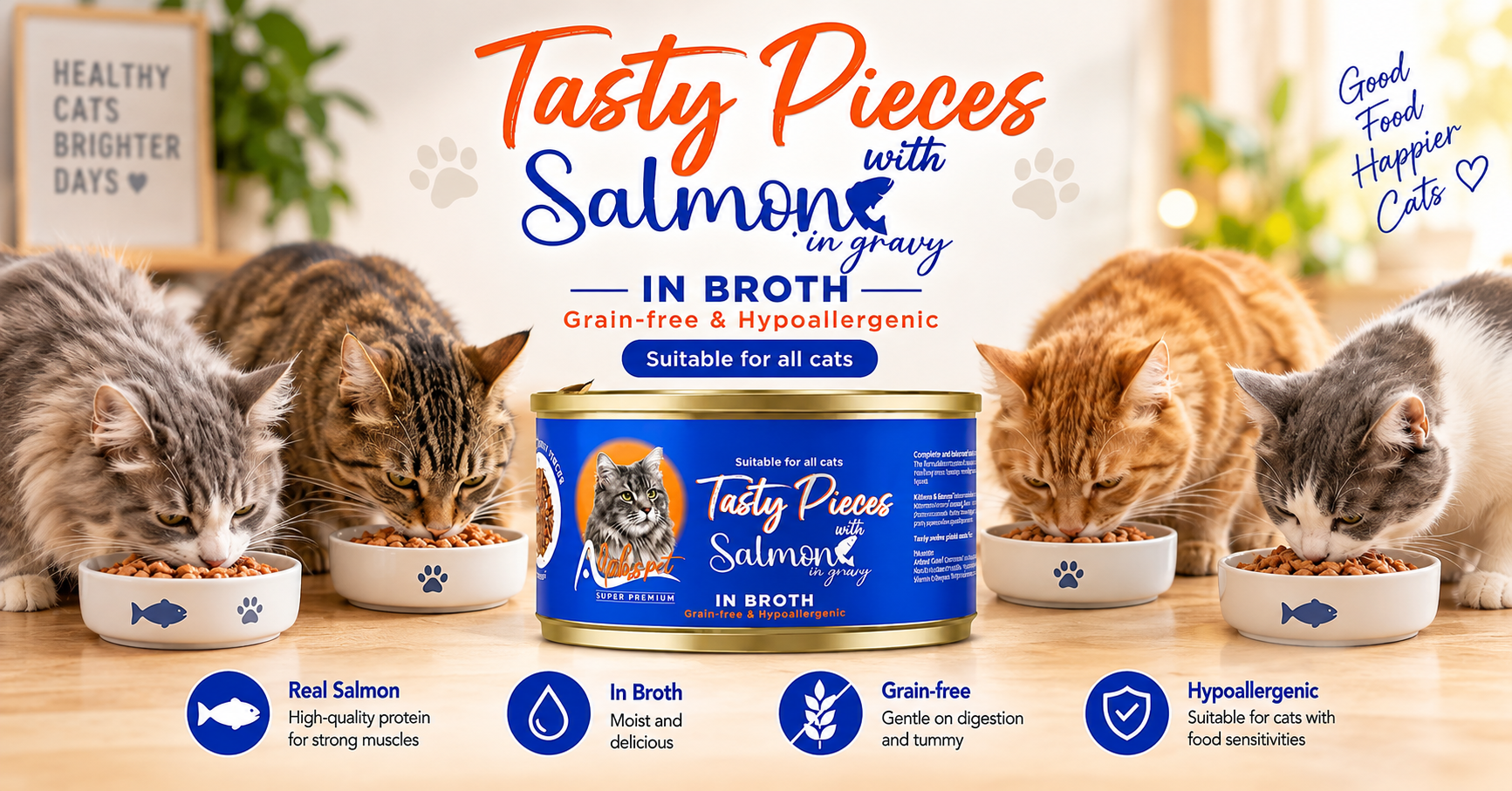
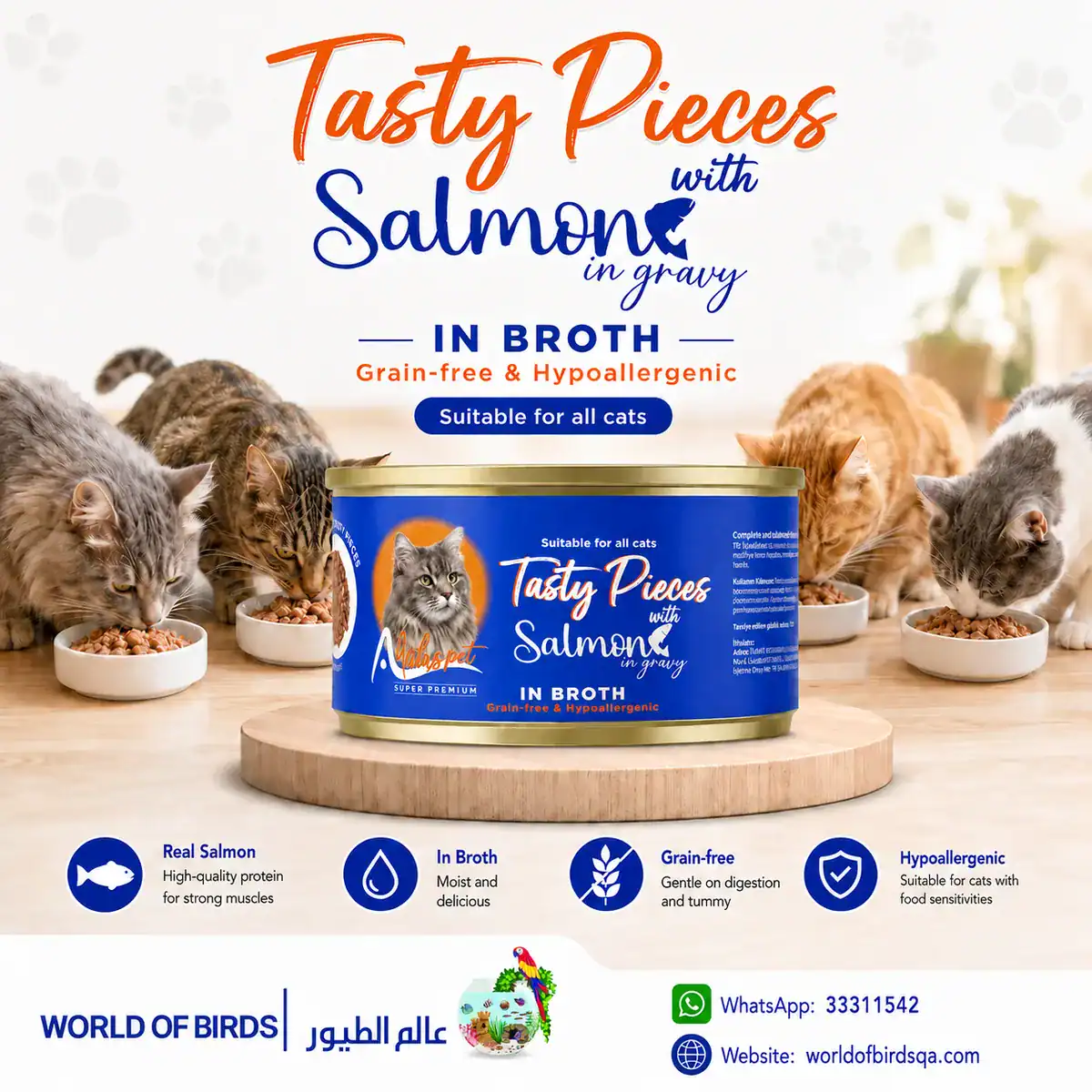
Our AlphaPet Tasty Pieces Salmon Wet Cat Food is listed as a grain-free, hypoallergenic wet formula with salmon pieces in gravy. The product page identifies it as complete and balanced and suitable for cats of all life stages.
Its wet format also provides dietary moisture.
This makes it a relevant option for owners specifically looking for a grain-free wet-food format rather than dry kibble.
Homie Super Premium Salmon
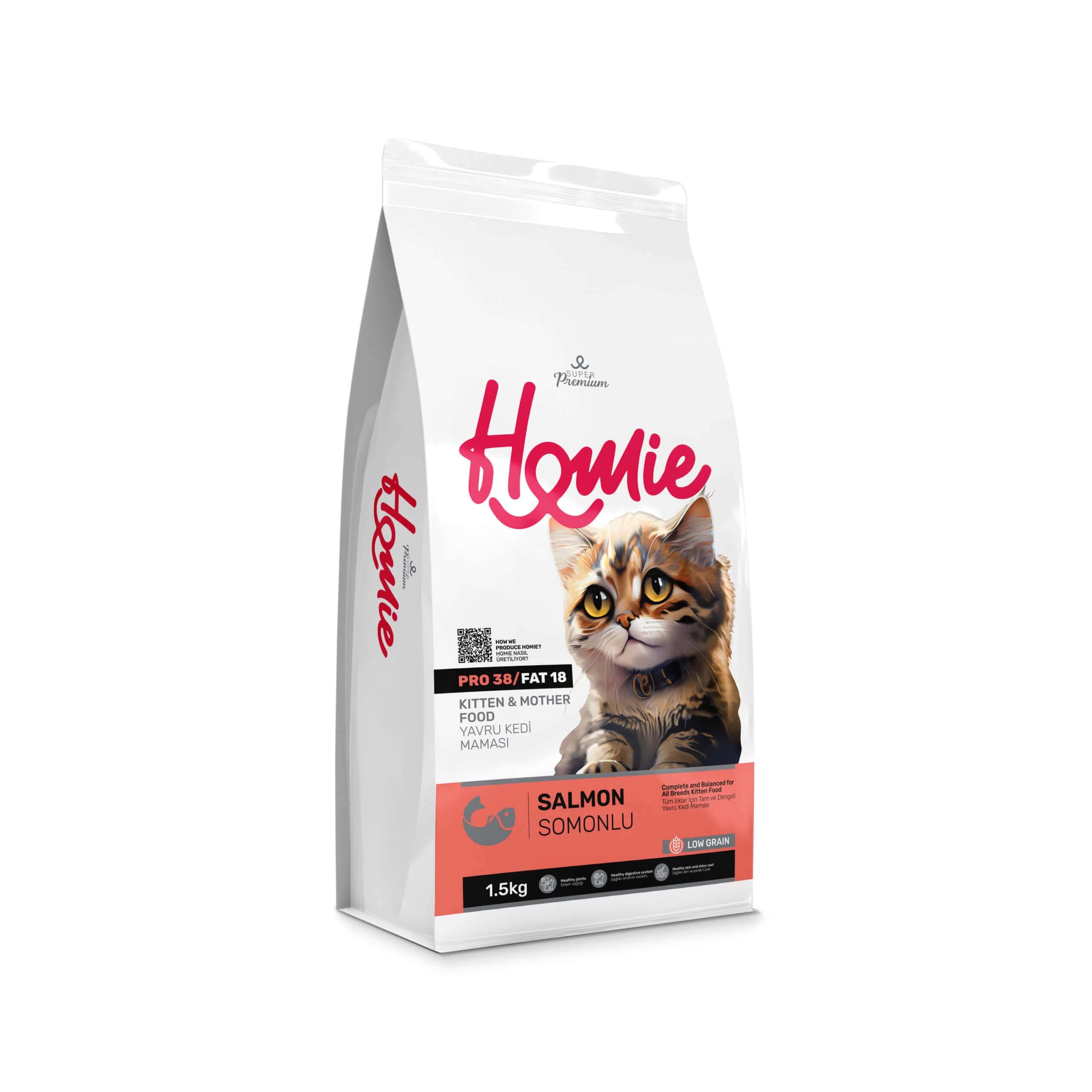
Our Homie Super Premium Salmon Adult Cat Food is a dry food listed as a grain-free formula for adult cats. The product page identifies salmon as the flavour and includes added vitamins, minerals and antioxidants.
It is intended for adult cats, so it should not be treated as a kitten diet.
Homie Low-Grain Options
Our Homie Super Premium Kitten & Mother Salmon Low Grain Cat Food is a different category. It is low-grain, not grain-free, and is listed for kittens and nursing mothers.
This distinction matters when comparing products. A low-grain formula should not be described as grain-free.
Grain-Free vs Grain-Inclusive Cat Food
Both grain-free and grain-inclusive foods can be suitable for cats when the complete formula meets their nutritional needs. The more relevant question is whether the specific diet suits the cat’s life stage, health and tolerance.
| Factor | Grain-Free | Grain-Inclusive |
| Contains cereal grains | No | Yes |
| Automatically higher protein | No | No |
| Automatically lower carbohydrate | No | No |
| Suitable for healthy cats | Can be | Can be |
| Useful for confirmed grain reaction | May be | Usually not if the trigger is confirmed |
| Requires complete nutrition | Yes | Yes |
| Requires veterinary diet for medical conditions | Sometimes | Sometimes |
There is no need to remove grains simply because they are present in a complete cat food.
Likewise, there is no reason to reject a properly formulated grain-free food simply because it lacks grains.
The individual cat and complete nutritional profile matter more than the label category.
Is Grain-Free Better for Cats in Qatar?
Grain-free cat food is not automatically better for cats in Qatar. Qatar’s climate makes practical feeding factors such as fresh water, appropriate portions, food storage and suitable nutrition important, but geography does not create a general nutritional requirement for grain-free food.
At World of Birds in Doha, we carry both grain-free and grain-inclusive options.
For dry-food feeding, our guide to dry cat food in Qatar covers label reading, protein, fibre, feeding amounts and life-stage considerations.
Qatar Feeding Considerations
For indoor cats in Doha:
- Keep dry food sealed after opening.
- Store food away from direct heat and sunlight.
- Provide fresh drinking water.
- Follow the feeding instructions.
- Monitor body weight.
- Avoid unnecessary diet changes.
- Keep wet food refrigerated after opening as directed.
- Contact a veterinarian when persistent health symptoms appear.
These habits matter regardless of whether the food contains grains.
When Should a Cat See a Veterinarian?
A veterinarian should assess a cat with persistent digestive, skin, appetite or weight problems instead of assuming that grain-free food will solve the issue. Food reactions can have several causes, and symptoms alone cannot identify the responsible ingredient.
Seek veterinary advice when your cat has:
- Repeated vomiting
- Persistent diarrhoea
- Significant weight loss
- Ongoing itching
- Skin inflammation
- Poor appetite
- Marked lethargy
- Recurring digestive problems
- A diagnosed medical condition
If a food allergy is suspected, a controlled elimination diet is more reliable than repeatedly changing commercial foods based on marketing labels.
Frequently Asked Questions
Is grain-free cat food good for cats?
Grain-free cat food can be suitable for cats, but it is not automatically healthier than grain-inclusive food. For most healthy cats, the priority is a complete and balanced diet that meets the cat’s life-stage and nutritional requirements.
Do cats need grain-free food?
No, healthy cats do not have an established requirement to avoid grains. Properly formulated cat food can include grains such as rice, corn, wheat or oats while still providing complete nutrition. Grain-free food may have a specific role when a cat has a confirmed dietary reaction.
Is grain-free cat food better for sensitive stomachs?
Not automatically. Digestive problems can result from food intolerance, protein sources, sudden diet changes or medical conditions. A grain-free formula may suit an individual cat, but the label alone does not establish that it will improve digestion.
Can grain-free cat food cause health problems?
Grain-free cat food is not inherently harmful simply because it contains no grains. The greater concern is relying on the grain-free label instead of checking complete nutrition, life stage and formulation. Grain-free diets can also contain other carbohydrate sources.
Are cats allergic to grains?
Cats can have reactions to grains, but grain allergies are considered uncommon. Animal proteins such as beef, fish and chicken are more commonly associated with feline food allergies. Proper diagnosis usually requires a controlled elimination diet under veterinary guidance.
Is grain-free the same as low-carb cat food?
No. Grain-free cat food can still contain significant carbohydrates from ingredients such as potatoes, peas, lentils or tapioca. Grain-free describes the absence of cereal grains, while low-carbohydrate describes the overall carbohydrate content of the diet.
Should kittens eat grain-free cat food?
Kittens do not need grain-free food simply because they are kittens. They need a complete diet formulated for growth. If a kitten has a suspected food reaction, dietary changes should be discussed with a veterinarian.
Is Grain-Free Cat Food Good for Cats? Final Answer
For most healthy cats, grain-free cat food is an option, not a nutritional requirement. A grain-free label does not automatically mean higher protein, lower carbohydrate, better digestion or better overall health.
The more useful approach is to assess the complete formula, life stage, nutritional adequacy, feeding amount and how the individual cat responds. Grains can provide useful nutrients in properly formulated cat food, while grain-free formulas can also be appropriate for some cats.
At World of Birds in Souq Al Ali, Doha, we stock both grain-free and grain-inclusive cat foods for owners across Qatar. Our range includes products such as AlphaPet Tasty Pieces Salmon Wet Cat Food and Homie Super Premium Salmon Adult Cat Food, alongside low-grain and grain-inclusive options.
Visit World of Birds in Souq Al Ali, Doha or browse our cat food range in Qatar. Our team can help you compare available formulas based on your cat’s age, current diet and feeding needs.
