







Guppy Fish Care Guide for Qatar : Tank Setup, Breeding and Colour Varieties


No fish starts more Qatar aquarium hobbyists in the hobby than the Guppy.
Not the Betta or Goldfish. The Guppy. Small, colourful, forgiving of beginner mistakes, and so willing to breed that a tank of six quickly becomes a thriving colony – the Guppy is the fish that turns a casual purchase into a genuine hobby for more Qatar residents than any other species.
Guppy fish Qatar hobbyists keep are one of the most successful aquarium fish in the world. Native to South America, they have been selectively bred for over a century into hundreds of colour varieties, tail shapes, and fin patterns. Male Guppies are among the most visually striking fish available at any size – vivid, active, and endlessly varied.
Guppies (Poecilia reticulata) are small freshwater livebearers that give birth to live fry rather than laying eggs. Males grow to 2 to 3.5cm with spectacular flowing fins. Females grow to 4 to 6cm and are the larger, rounder sex. Both are peaceful, adaptable, and suitable for any community tank. In Qatar, they do not require a heater in most conditions but perform better with one.
At World of Birds Qatar, we have been selling Guppy Assorted at our Souq Al Ali store since 1985. Browse our live freshwater fish collection to see what is currently available.
In this blog, we’ll cover tank setup, water parameters, colour varieties, breeding management, tank mates, and everything Qatar guppy keepers need to know.
Why Guppies Are Qatar’s Most Popular Aquarium Fish
Ask any WOB staff member which fish they sell the most of across 41 years at Souq Al Ali. The answer is immediate: Guppies.
Not because they are the most expensive or they are the most dramatic. Because they work. Guppy fish Qatar buyers bring home, set up in a basic tank, and those fish survive beginner mistakes, adapt to a wide range of water conditions, and reward their owners with colour and activity from day one.
Three things make Guppies Qatar’s most popular fish.
- First, the male’s visual impact
- Second, their tolerability
- Third, their breeding
At World of Birds, we have been supplying Guppies to Qatar customers since 1985. They are the fish that started more Qatar aquarium hobbyists than any other species in our range. This guide covers everything you need to keep them thriving.
For a broader list of the best beginner fish available in Qatar, read our beginner aquarium fish guide for Qatar.
Browse our live freshwater fish collection to check current Guppy availability before visiting.
Guppy at a Glance : Quick Care Profile
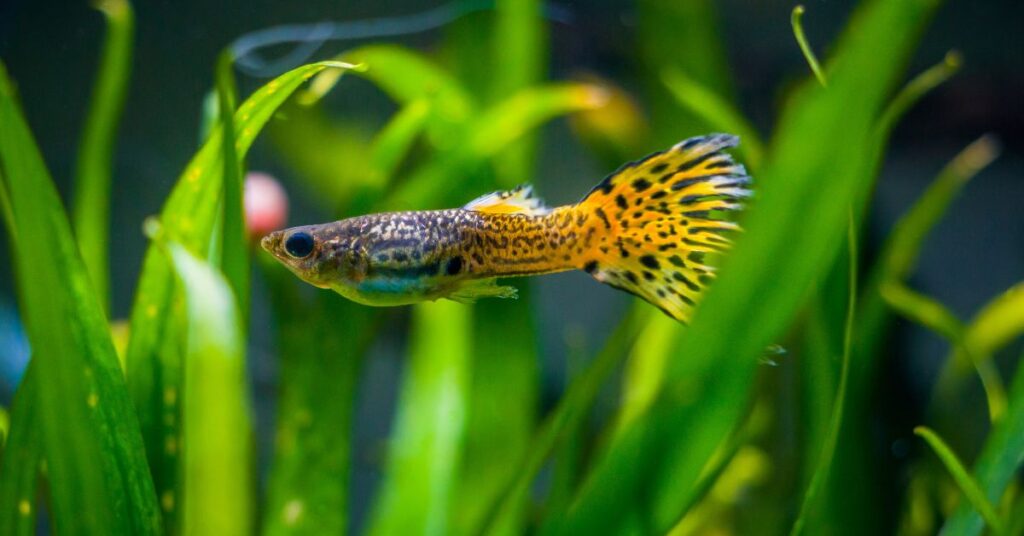
Guppies (Poecilia reticulata) are the world’s most widely kept freshwater fish – peaceful, colourful, easy to breed, and adaptable to a wider range of conditions than almost any other aquarium species.
| Scientific Name | Poecilia reticulata |
| Origin | South America – Venezuela, Guyana, Brazil, Trinidad |
| Adult Size | Males 2 to 3.5cm / Females 4 to 6cm |
| Care Level | Very Easy |
| Minimum Tank Size | 40 litres for a group of 6 to 8 |
| Temperature | 22 to 28°C (heater recommended in Qatar) |
| pH | 7.0 to 7.8 |
| Lifespan | 2 to 5 years |
| Temperament | Peaceful community fish |
| Diet | Omnivore – accepts all food types |
| Breeding | Livebearer – gives birth to live fry every 28 to 35 days |
Browse guppy fish at World of Birds to see current variety availability at our Souq Al Ali store.
Setting Up a Guppy Tank in Qatar
A Guppy tank does not need to be elaborate. It needs to be stable.
Minimum tank size: 40 litres for a starter group of 6 to 8 Guppies. This is the most commonly misunderstood point for Qatar beginners who purchase Guppies and place them in a 5 or 10-litre bowl or nano tank. A bowl has no filtration and no adequate water volume. The water quality deteriorates within 24 hours of adding fish, and the Guppies decline quickly regardless of how hardy they are.
A 40-litre tank provides sufficient water volume to buffer fluctuations in water quality as the nitrogen cycle establishes, enough space for Guppies to display natural swimming behaviour, and room for a small breeding colony to establish without immediate overcrowding.
Filter: A sponge filter or low-flow hang-on-back filter is the right choice for a guppy fish care setup. Guppies have long, flowing fins – strong filter currents push males sideways and stress them. A sponge filter provides biological filtration with a gentle water ripple. It is also the safest option for fry – standard intake tubes suck in baby Guppies.
Browse Aquariums and Stands at World of Birds and aquarium filters for setup options suitable for Qatar Guppy tanks.
Adding Live Plants to a Qatar Guppy Tank
Live plants benefit a guppy fish Qatar setup in two critical ways. First, they provide hiding spots for fry – dramatically increasing the number of baby Guppies that survive in a colony tank with adults. Second, the visual contrast between vivid male Guppy colouration and green plant backgrounds makes the colours appear more saturated and vivid.
Recommended plants from WOB’s stock: Anubias Nana (attaches to driftwood, very low maintenance, no CO2 required) and Water Wisteria (fast-growing stem plant that creates dense fry-hiding zones within weeks of planting). Both available at World of Birds Souq Al Ali.
For a complete planted tank setup guide, read our planted aquarium guide for Qatar.
Guppy Water Parameters – Does Qatar Tap Water Suit Guppies?

The ideal water parameters for guppy fish Qatar setups:
- Temperature: 22 to 28°C (see heater section below)
- pH: 7.0 to 7.8
- Ammonia: 0 ppm (always)
- Nitrite: 0 ppm (always)
- Nitrate: below 20 ppm
- Water hardness: 8 to 15 dGH (moderately hard)
Qatar’s tap water is actually well-suited to Guppies – one of the clearest advantages for Qatar Guppy keepers. Guppies naturally originate from the hard, slightly alkaline rivers and coastal streams of Venezuela, Trinidad, and Guyana. Doha’s desalination water is moderately hard with a slightly alkaline pH – matching Guppy preferences closely without any pH adjustment.
Water conditioner is still essential before any Doha tap water addition – chloramine removal protects both the fish and the beneficial bacteria in the filter.
Find water conditioners at World of Birds for the right conditioner for your Qatar Guppy setup.
Do Guppies Need a Heater in Qatar?
The honest Qatar-specific answer: recommended but not strictly essential.
Guppies prefer 22 to 28°C. Qatar’s AC-cooled rooms maintain 20 to 23°C in summer and can drop lower in winter – sitting just below the ideal lower end of the Guppy’s comfort range.
At 20 to 22°C without a heater, Guppies in Qatar survive without visible distress. They feed, they swim, and they live. But three things change noticeably at cooler temperatures:
Colour fades. Male Guppy colouration is more vivid at 24 to 26°C than at 20 to 22°C.
Breeding slows. At 20°C, guppy breeding frequency drops significantly. Females produce fewer fry per brood and the interval between broods lengthens.
Qatar recommendation: A heater set to 24 to 25°C is a worthwhile investment for any guppy fish care setup in Qatar – it significantly improves colour and activity and keeps the tank at a consistent temperature regardless of overnight AC fluctuations. It is not the emergency requirement it is for Bettas, Angelfish, or Discus – but it noticeably improves the quality of the display.
What to Feed Guppy Fish in Qatar – Guppy Fish Diet
Guppies accept virtually any aquarium food – their dietary flexibility is one of the reasons they are such successful beginner fish. The guppy fish diet should centre on high-quality tropical fish flakes or micro-pellets, supplemented with protein treats.
Staple food: High-quality tropical fish flakes or micro-pellets. Look for flakes with fish meal as the first ingredient, not wheat or corn filler. The protein quality of the staple food directly determines male colour intensity.
Supplement with (2 to 3 times per week):
- Frozen bloodworms – the single best colour-enhancing treat for male Guppies
- Baby brine shrimp – essential for fry growth and colour development
- Blanched spinach or cucumber – provides vegetable matter
Adults once or twice daily, only what is consumed in 2 minutes. Remove uneaten food immediately. Fry: 3 to 4 times daily with finely crushed flakes or powdered fry food.
Browse fish food for guppies at World of Birds for flakes, frozen food, and fry food options available in Doha.
Foods That Enhance Guppy Colour in Qatar
Male Guppy colour is partially diet-determined. Foods containing astaxanthin (produces red and orange colouration) and spirulina (enhances blue and iridescent colouration) noticeably intensify fin and body colour in males within 3 to 4 weeks of consistent feeding.
Frozen bloodworms are the most practical colour-enhancing food for Qatar Guppy keepers. Two to three bloodworm feedings per week maintain and intensify red, orange, and blue pigmentation in male fins – the difference versus flake-only diet is visible within a month.
Fancy Guppy Colour Varieties Available in Qatar
The Guppy’s most remarkable characteristic is its visual diversity. More named varieties of Guppy exist than of any other aquarium fish – the result of over a century of selective breeding. At World of Birds, we stock Guppy Assorted – a mix of colour varieties and tail shapes from each shipment.
Guppy fish colours range from single-colour solid morphs to complex multi-coloured patterns. Here is what Qatar buyers may encounter when selecting from assorted stock.
Tail Shape Varieties – What to Look For in Qatar Shops
Veiltail: Long, flowing single tail that drapes downward. The most common tail type in Qatar shops – elegant and recognisable.
Delta Tail: Large, wide tail that fans out in a triangular shape. One of the most impressive tail types – the large fin surface area shows the full colour pattern.
Lyre Tail: Upper and lower tail rays extended symmetrically, creating a fork shape. Relatively uncommon in assorted stock – worth selecting if available.
Swordtail: A single extended lower tail ray, resembling a sword. Not to be confused with Swordtail fish – a Guppy Swordtail is a tail shape variety of the same Guppy species.
Fantail: Rounded, symmetrical tail with a fan-shaped profile. Compact and elegant – suits smaller tanks where longer-tailed varieties might be stressed by gentle filter flow.
Body and Colour Pattern Varieties
Tuxedo: Dark black or navy lower body contrasting sharply with vivid colour on the upper body and tail. One of the most dramatic-looking fancy guppy Qatar varieties.
Cobra: Vertical black striping across the body with iridescent green or gold scale colouration between the stripes. Very popular among Qatar buyers.
Snakeskin: Fine net-like or chain-mail pattern across the full body surface. Different from Cobra in that the pattern is finer and more uniform.
Lace: Delicate, filigree-style pattern on the fins. Subtle and elegant – shows best under cool-spectrum LED lighting.
Endler’s Guppy: Smaller than fancy Guppies, with more compact fins and wild-type colour patterns (black, orange, and iridescent green). More active than fancy varieties. Compatible with regular Guppies but best kept separately to maintain the Endler’s characteristics across generations.
How Do Guppies Breed? Understanding the Qatar Guppy Breeding Cycle
Guppy breeding in Qatar does not require any deliberate intervention. Buy a mixed group, put them in a stable tank, and breeding begins within days.
How to sex Guppies:
- Males: smaller body (2 to 3.5cm), vivid colours, long flowing fins, narrow pointed gonopodium (anal fin)
- Females: larger body (4 to 6cm), duller colouration, rounded fan-shaped anal fin
The breeding cycle: A female stores sperm after a single mating and produces successive broods without further male contact. One female purchased pregnant from a shop can produce fry for 6 months continuously. Gestation: 28 to 35 days. Brood size: 20 to 50 fry. Fry are born fully-formed and free-swimming, able to eat solid food within hours of birth.
Pregnancy signs: The female’s abdomen becomes noticeably rounder. The gravid spot (a dark patch near the anal fin) darkens and enlarges. Pregnant females often seek shelter near the substrate in the final days before birth.
Guppy breeding activity is consistent year-round in Qatar’s AC rooms. The slight cooling of Qatar’s winter months may slightly reduce breeding frequency but does not stop it.
Browse live aquatic plants for your guppy breeding tank – dense plant cover dramatically increases fry survival.
How to Save Guppy Fry in Qatar
Three approaches work for Qatar Guppy keepers:
Dense plant cover: Water Wisteria and floating plants create hiding zones where some fry survive. A planted tank typically sustains 10 to 20% of each brood to adulthood – enough to maintain colony growth without overwhelming the tank.
Breeding trap or separate tank: Isolate the pregnant female 24 to 48 hours before birth. Return the female to the main tank after birth. This maximises fry survival.
Natural selection: Allow adults and tank mates to consume surplus fry naturally. The colony stabilises at the tank’s carrying capacity. The lowest-maintenance approach for Qatar apartment Guppy keepers.
Guppy Fry Care in Qatar – From Birth to Adult
Fry eat solid food immediately from birth. Feed 3 to 4 times daily with finely crushed adult flakes or powdered fry food. Baby brine shrimp accelerates growth and colour development dramatically.
Water changes for fry: 10 to 15% daily is ideal – fry are more sensitive to nitrate accumulation than adults. In Qatar’s warm rooms, consistent small daily changes are better than infrequent larger ones.
Male fry develop colour at approximately 6 to 8 weeks. Breeding age is reached at approximately 3 months.
Managing Guppy Overpopulation in Qatar
A single female produces 20 to 50 fry every 28 to 35 days from stored sperm. A tank of 6 Guppies (3 males, 3 females) can produce 150+ fry within the first 3 months. Managing this population growth in a Qatar apartment requires a clear plan.
Three realistic approaches:
Males only: The simplest solution. A males-only Guppy tank produces zero fry, displays maximum colour, and requires no fry management. Many guppy fish Qatar customers specifically request males only at our Souq Al Ali store.
Natural population management: Dense plant cover plus tank mates that consume fry. The colony self-regulates as the tank reaches carrying capacity.
Controlled breeding programme: A dedicated breeding tank for selected pairs, fry raised in a separate grow-out tank, surplus fry rehomed. Qatar’s growing aquarium community – reachable through WhatsApp groups – provides an outlet for surplus Guppies that other new hobbyists are happy to receive.
Guppy Tank Mates – Which Fish Are Safe in Qatar?
Guppies are peaceful community fish. Their tank mate limitations are about protecting the Guppies’ flowing fins from species that fin-nip, and protecting small fry from larger fish.
Safe tank mates available at World of Birds Qatar:
- Corydoras Catfish – bottom dwellers that completely ignore Guppies and clean substrate.
- Zebra Danios – active, fast, non-aggressive, and share similar water parameter requirements.
- Mollies – livebearer family members with nearly identical care requirements. Peaceful and compatible.
- Balloon Mollies – peaceful, colourful, and compatible with Guppy water parameters.
For shrimp and Guppy compatibility guidance, read our aquarium shrimp guide for Qatar – adult Guppies are generally safe with adult shrimp but will eat baby shrimp.
Browse freshwater fish compatible with guppies at World of Birds to see current community fish stock.
Can Guppies Live With Betta Fish in Qatar?
No. This is the most common guppy tank mates mistake at our Souq Al Ali store – customers buying Bettas and Guppies together assuming they are compatible.
Betta Fish attack male Guppies. The long, flowing fins of a male Guppy trigger the same territorial aggression that Betta males show toward each other. Even a normally calm female Betta will harass male Guppies continuously in a shared tank. The Guppy’s fins are shredded, the stress leads to disease, and most male Guppies in a Betta tank do not survive long.
Read our Betta Fish care guide for Qatar for full compatibility guidance.
Common Guppy Health Problems in Qatar
Most Guppy health problems in Qatar are preventable with correct setup and regular water changes. The fish is hardy – but hardiness has limits when water quality deteriorates.
Find fish health products at World of Birds for treatment and preventative care options.
Fin Rot – The Most Common Qatar Guppy Problem
Ragged, discoloured fin edges that progress toward the body. The single most common guppy fish care problem in Qatar tanks – caused by poor water quality from overfeeding and infrequent water changes.
Ich (White Spot) – Temperature Shock Risk
White spots on body and fins, fish scratches against décor. Triggered by temperature drops – relevant in Qatar when AC rooms cool below 20°C overnight without a heater.
Swim Bladder Disease
Fish floating sideways or swimming at a permanent angle. Caused by overfeeding dry food that expands in the stomach.
Wasting Disease
Males becoming progressively thinner despite eating actively. Caused by internal parasites – Camallanus worms are the most common culprit in imported Guppies.
Colour Fading in Male Guppies
Males losing colour intensity over weeks without other visible symptoms. Caused by: stress from fin-nipping tank mates, insufficient light, poor diet lacking carotenoids, chronic low-level water quality issues, or temperature too low.
How Long Do Guppy Fish Live?
Guppy fish lifespan with correct care: 2 to 5 years. Most Guppies in well-maintained Qatar tanks live 2 to 3 years.
Guppies kept at cooler temperatures (20 to 23°C without a heater in Qatar’s AC rooms) sometimes show longer individual lifespans than those kept at 26 to 28°C – cooler temperatures slow metabolism and extend the biological timeline, even while reducing guppy breeding frequency.
Stable water parameters, quality varied diet with colour-enhancing foods, compatible peaceful tank mates, heater maintaining 24 to 25°C, weekly water changes.
What shortens it: Temperature fluctuations from AC cycling overnight, fin rot from overfeeding and infrequent water changes, chronic stress from fin-nipping tank mates, overcrowding as the colony grows without population management.
Where to Buy Guppy Fish in Qatar – World of Birds, Souq Al Ali
World of Birds has been supplying Guppy fish to Qatar customers since 1985. Our Souq Al Ali store stocks Guppy Assorted year-round – a mix of colour varieties and tail shapes from every shipment. We also stock everything needed for a complete guppy fish Qatar setup in one visit: tanks, sponge filters, heaters, water conditioners, flake food, frozen bloodworms, and live Anubias plants.
Ask our staff which colour varieties are currently in the tanks. WOB staff can identify tail shapes and colour patterns to help Qatar buyers select specific combinations – males only, specific colour morphs, or balanced male-female groups for a breeding colony.
To buy guppy fish Doha from a trusted supplier with 41 years of Qatar experience, visit us or message us on WhatsApp first to confirm availability.
Before visiting, read our guide to buying healthy fish in Qatar.
Message us on 33311542 via WhatsApp to confirm what colours and tail types are in stock.
Browse our live freshwater fish collection at World of Birds online to see current stock.
Frequently Asked Questions About Guppy Fish in Qatar
Do guppies need a heater in Qatar?
Guppies prefer 22 to 28°C. Qatar’s AC-cooled rooms maintain 20 to 23°C – just below the ideal lower end. Guppy fish Qatar setups without a heater produce fish that survive but show less vivid colour and slower guppy breeding activity. A heater set to 24 to 25°C noticeably improves colour intensity and activity. It is recommended but not the emergency requirement it is for Bettas or Angelfish.
How do guppies breed in Qatar?
Guppies are livebearers – females give birth to live fry every 28 to 35 days. A female stores sperm after a single mating and produces multiple broods without further male contact. A mixed group of guppy fish buyers purchase will begin breeding within weeks. Guppy breeding in Qatar is consistent year-round. Dense plant cover and population management planning are important before buying a mixed group.
What are the different types of fancy guppies available in Qatar?
World of Birds stocks fancy guppy Qatar assorted varieties including Veiltail, Delta Tail, Tuxedo, Cobra, Snakeskin, and Lace patterns in a range of guppy fish colours. The specific varieties available depend on each shipment. Contact us on WhatsApp at 33311542 to ask which varieties are currently in stock.
What fish can live with guppies in Qatar?
Safe guppy tank mates in Qatar include Corydoras Catfish, Zebra Danios, Mollies, and Platies. Never keep Guppies with Betta Fish (will attack males), Tiger Barbs (fin-nippers), or any fish large enough to eat Guppies. A guppy community tank with Mollies and Corydoras is one of the most reliable combinations available at World of Birds.
Where can I buy guppy fish in Qatar?
World of Birds at Souq Al Ali, Doha stocks guppy fish Qatar buyers need year-round. We have been supplying guppies in Qatar since 1985. Contact us on WhatsApp at 33311542 to check current guppy fish colours and variety availability before visiting. Buy guppy fish Doha from a trusted source with 41 years of Qatar aquarium experience.
Ready to Start Your Guppy Tank? Visit World of Birds Qatar Today
Guppy fish Qatar hobbyists keep are the most practical, most colourful, and most reliably rewarding beginner fish available in Doha. A 40-litre planted tank with a group of Guppy Assorted, a sponge filter, and weekly water changes is one of the most achievable and most satisfying aquarium setups possible in Qatar.
The fish are beautiful. The care is simple. And once a breeding colony establishes, the tank becomes a living, self-sustaining ecosystem that new Qatar hobbyists find genuinely absorbing.
Browse guppy fish now in stock at World of Birds, or message us on WhatsApp at 33311542 to check current variety availability before visiting. Visit us at Souq Al Ali, Doha – Qatar’s oldest pet and aquatic store, open since 1985. Find us on Google Maps.
