







How Many Fish Can I Put in a Tank? Stocking Guide

How many fish can I put in a tank? There is no single number that works for every aquarium. Safe stocking depends on tank volume, adult fish size, species behaviour, filtration, swimming space and water quality.
At World of Birds in Souq Al Ali, Doha, we help aquarium owners choose tanks, filters and suitable aquatic supplies. Our published aquarium guides also show why tank size alone cannot determine stocking capacity.
This guide focuses specifically on how many fish you can keep in a tank. You will learn practical stocking ranges, why simple rules can fail, and how to add fish safely.
Quick answer: Start with fewer fish than your aquarium’s theoretical capacity. Always plan around adult size, species requirements, filtration and water quality.
How Many Fish Can I Put in a Tank?
You can keep only as many fish as your aquarium can safely support based on space, bioload, behaviour and water quality. A 60-litre aquarium could suit a small community, but the same volume may be unsuitable for larger or territorial fish.
This means tank capacity cannot be converted into one universal fish count.
OATA states that it is not possible to give an exact stocking number for every aquarium. Species requirements, body size, water parameters and compatibility all change the answer.
Why Fish Count Alone Is Misleading
Two aquariums can contain the same number of fish and have very different biological loads. Ten tiny schooling fish may produce less waste than two large, messy fish.
Swimming behaviour also changes the amount of usable space each species needs.
Therefore, how many fish can I put in a tank should always be answered using the specific fish you plan to keep.
How Many Fish Per Tank Size?
Tank size provides a starting point, but stocking should remain conservative until species requirements are checked. The table below gives practical planning examples for small freshwater community fish.
| Tank size | Conservative starting approach | Important note |
| 20 litres | One suitable small fish or carefully selected nano setup | Very limited capacity |
| 40 litres | One small school of compatible fish | Avoid mixing too many species |
| 60 litres | One or two compatible groups | Check adult size and behaviour |
| 100 litres | Small community with several compatible groups | More flexibility |
| 200 litres | Larger community or larger species | Species requirements still control stocking |
These examples are not universal stocking limits.
A 100-litre tank does not automatically support twice the fish of a 50-litre tank.
The final number depends on the livestock and aquarium design.
Why Larger Tanks Give More Margin
Larger aquariums generally provide more stable water conditions.
RSPCA explains that larger volumes are less vulnerable to rapid changes in temperature and water quality.
This does not mean a larger tank permits unlimited fish. It simply provides more room for appropriate stocking and better stability.
Does the One-Inch-Per-Gallon Rule Work?
The one-inch-per-gallon rule is only a rough guideline and should not determine your final stocking level. Aqueon still presents it as a general rule of thumb, but also says activity, territory, habitat and filtration must be considered.
The problem is that fish are not identical shapes.
A long, slender fish and a deep-bodied fish can have the same length but very different body mass.
Their waste production and swimming requirements can also differ significantly.
Why the Rule Can Fail
The rule does not properly account for:
- Adult body mass
- Waste production
- Swimming behaviour
- Territorial behaviour
- Schooling requirements
- Filtration
- Tank footprint
- Water-change routine
For this reason, treat the rule as a warning against obvious overcrowding.
Do not use it as permission to fill every available litre.
What Determines Aquarium Stocking Capacity?
Aquarium stocking capacity depends on several factors working together rather than tank volume alone. The safest stocking level is determined by whichever limitation becomes restrictive first.
Adult Fish Size
Always plan for the adult fish. A juvenile fish may look tiny when purchased but can grow considerably.
OATA recommends choosing an aquarium that can accommodate fish once they are fully grown.
Fish Behaviour
Territorial species need more personal space.
Some fish also require specific swimming areas or hiding places.
A peaceful schooling species and a territorial species therefore cannot be stocked using the same calculation.
Schooling Requirements
Many community fish need groups rather than individual housing.
RSPCA notes that many tropical shoaling fish should be kept in groups of six or more.
That requirement changes the stocking calculation. You cannot simply add three different schooling species because each fish is small.
Swimming Space
Tank footprint matters. Active swimmers often need more horizontal space than a tall aquarium provides.
RSPCA also notes that surface area supports oxygen exchange, making wide tanks useful for fishkeeping.
How Does Filtration Affect Fish Stocking?
Filtration helps process waste, but a powerful filter does not automatically allow more fish. Filtration supports water quality, while the aquarium still has physical and behavioural limits.
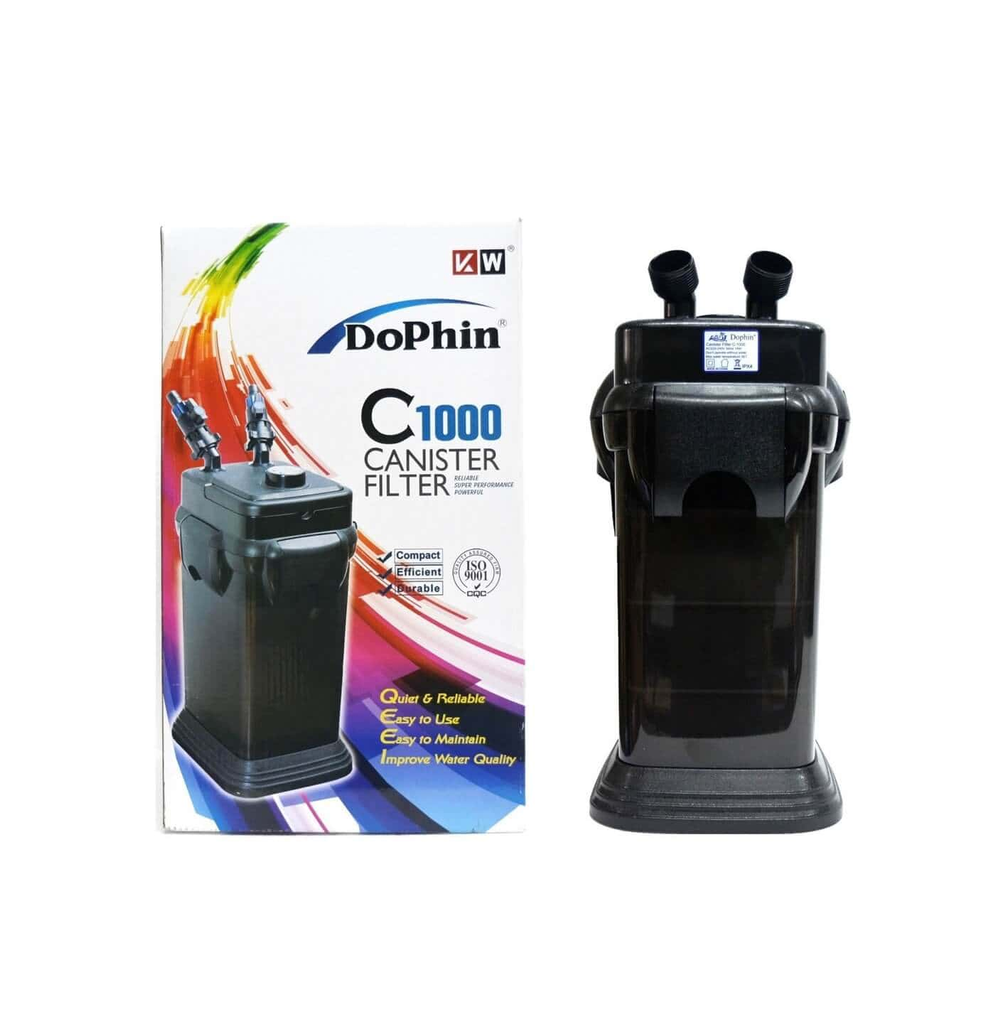
For example, the Dophin C1000 Aquarium Canister Filter 1650 L/H provides multi-stage filtration and a listed flow rate of 1,650 L/H.
However, stronger filtration does not create more swimming room. It also does not fix incompatible tank mates.
What Happens When Filtration Cannot Handle the Load?
Too many fish increase the amount of waste entering the aquarium. If biological filtration cannot process that waste, ammonia and nitrite can become dangerous.
OATA warns that overstocking can contribute to unhealthy ammonia and nitrite levels.
This is why filtration should support a sensible stocking plan. It should not be used to justify excessive stocking.
How Many Fish Should You Add at Once?
Add fish gradually rather than filling a newly established aquarium immediately. Beneficial bacteria need time to increase as the biological waste load increases.
Merck Veterinary Manual recommends adding fish gradually, often one or two at a time, to allow bacterial colonies to adapt.
A practical approach is:
- Cycle and prepare the aquarium first.
- Confirm ammonia and nitrite are at appropriate levels.
- Add a small initial group.
- Monitor water quality.
- Allow the system to stabilise.
- Add another small group if conditions remain suitable.
- Recheck compatibility before every addition.
Do not add new fish simply because the tank still looks empty.
What Fish Can Live Together?
Compatible fish should have similar water requirements, temperature preferences, behaviour and social needs. Fish that require different conditions should not be combined simply because they fit physically inside the same aquarium.
For example, schooling fish usually need appropriate groups. Territorial fish may need separate territories.
Different swimming levels can also help use the aquarium space more effectively.
Community Fish
World of Birds currently highlights species such as Guppies, Zebra Danios, Glo Tetras, Mollies and Platies among freshwater options for Qatar beginners.
However, each species still has its own requirements.
For species-specific recommendations, read our Top 10 Freshwater Aquarium Fish for Beginners in Qatar guide.
That article focuses on fish selection rather than stocking calculations.
How Many Fish Can I Put in a 40-Litre Tank?
A 40-litre aquarium should be stocked conservatively with a compatible small group rather than a large mixed community. The exact number depends on adult fish size, schooling requirements, filtration and the tank’s dimensions.
For example, six small compatible schooling fish may be a more sensible starting point than several different species.
Do not assume six fish always equals a safe stocking level. Species-specific requirements can change the answer significantly.
World of Birds’ aquarium guidance also identifies 40 litres as a practical starting size for several beginner community setups.
How Many Fish Can I Put in a 60-Litre Tank?
A 60-litre aquarium offers more flexibility than a 40-litre tank, but the fish species still determine the safe stocking level. A carefully planned small community can work, while larger or territorial fish may require considerably more space.
Use the additional volume for stability and swimming room. Do not treat it as permission to double your fish count automatically.
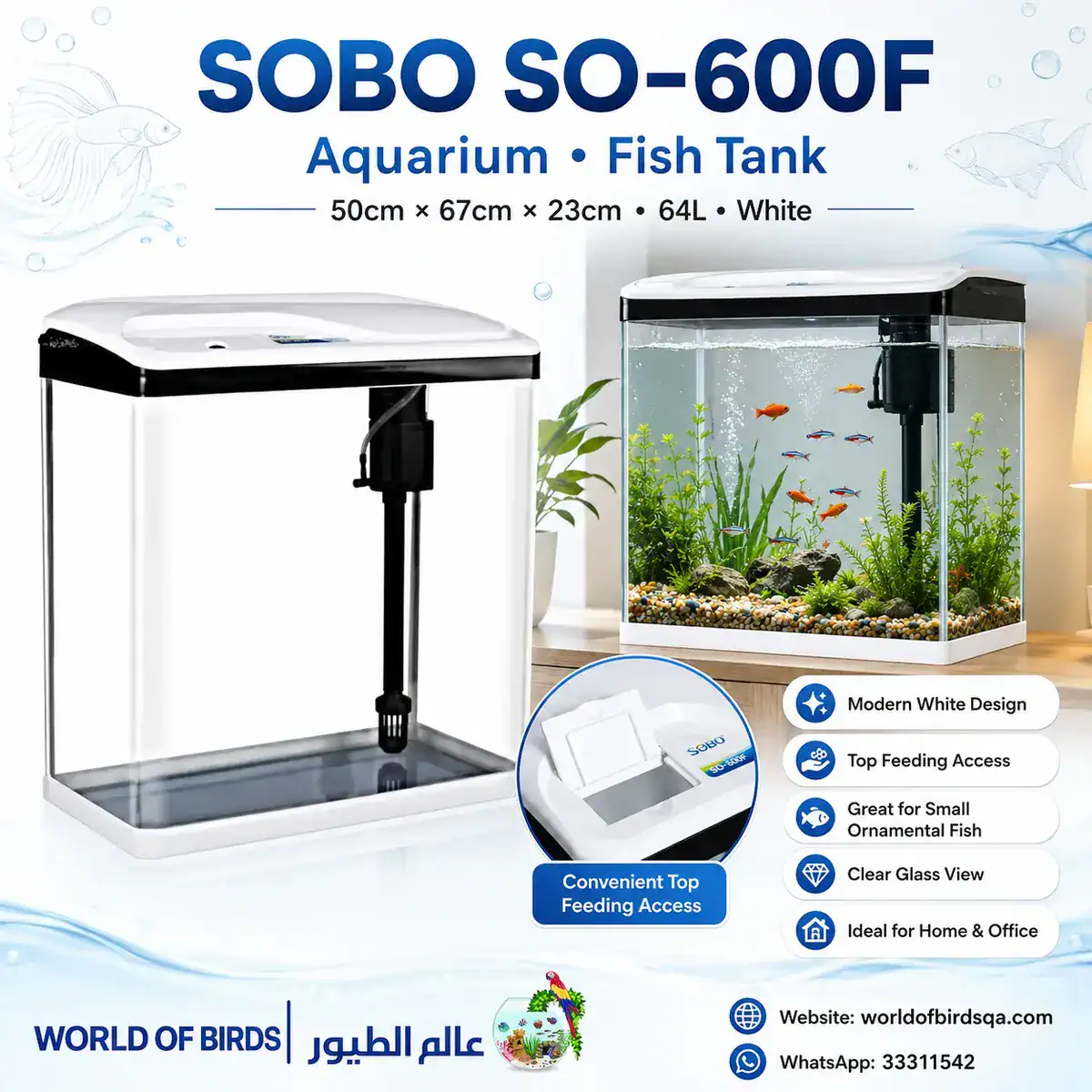
If you are considering a 60-litre setup, the SOBO SO-600F Aquarium Fish Tank 64L is currently listed by World of Birds with a 64-litre capacity.
Its larger volume gives more flexibility than the store’s compact 4L and 9L models.
How Many Fish Can I Put in a 100-Litre Tank?
A 100-litre aquarium can support a wider range of freshwater communities, but there is still no universal fish count. You should calculate the stocking plan from adult size, group requirements, territory, filtration and water quality.
A 100-litre tank can support more options than a 40-litre setup.
However, large fish can quickly consume that additional capacity. A peaceful small-fish community and a group of large cichlids require completely different planning.
Why Tank Shape Matters for Stocking
Tank dimensions can matter as much as total litres because fish need usable swimming space and adequate surface area. A long aquarium can provide more horizontal movement than a tall tank with similar volume.
It also recommends wider tanks because they provide greater surface area relative to water volume.
Consider these dimensions:
- Tank length
- Tank width
- Tank height
- Water depth
- Swimming zone
- Surface area
- Substrate and décor displacement
Do not calculate stocking from the manufacturer’s stated capacity alone. Actual usable water volume can be lower after substrate, rocks and decorations are installed.
Does Overfeeding Affect How Many Fish You Can Keep?
Yes, feeding habits affect the aquarium’s waste load and therefore influence how much stocking the system can comfortably handle. Excess food decomposes and adds organic waste to the aquarium.
World of Birds’ Overfeeding Aquarium Fish: 7 Signs You’re Feeding Too Much explains how excess feeding can contribute to cloudy water, algae, ammonia problems and faster filter clogging.
Food should therefore match the actual fish population. A large aquarium does not automatically require more food.
Choose Food for the Fish
World of Birds currently stocks several aquarium food formats.
For example, SISO 1000ml Basic Flake Fish Food for Tropical Fish is listed for tropical and ornamental fish.
The SISO 100g Floating Pellet Fish Food for Aquariums is another option for tropical and ornamental fish that feed near the surface.
For choosing between food formats, read our Fish Flakes vs Pellets: Which Is Better for Aquarium Fish? guide.
How Do You Know If Your Tank Is Overstocked?
An aquarium may be overstocked when fish show stress, water quality deteriorates, aggression increases or filtration becomes overwhelmed. Visible water clarity alone cannot confirm that stocking levels are safe.
Watch for:
- Persistent ammonia readings
- Detectable nitrite
- Rapid nitrate accumulation
- Frequent cloudy water
- Fish gasping at the surface
- Persistent aggression
- Insufficient swimming space
- Rapid filter clogging
- Frequent unexplained fish illness
RSPCA warns that too many fish can pollute water and reduce available oxygen. If several warning signs appear together, stop adding fish. Test the water and review stocking, feeding and filtration.
What Should You Check Before Adding More Fish?
Check the aquarium’s water quality, current livestock, adult sizes, compatibility and filtration before buying additional fish. Adding another fish should be a planned decision rather than an impulse purchase.
Use this checklist:
- Is the aquarium fully established?
- Are ammonia and nitrite at safe levels?
- Is nitrate under control?
- What is the adult size of each fish?
- Does the species need a group?
- Does it need territorial space?
- Will it compete with existing fish?
- Is the filtration appropriate?
- Is there enough swimming room?
- Can you maintain the required water-change routine?
For new arrivals, also follow our How to Acclimate New Fish to an Aquarium Without Stress guide.
How Many Fish Can You Safely Keep?
The safest aquarium stocking level is usually lower than the maximum theoretical capacity. A lightly stocked aquarium provides more room for changes in water quality, fish growth and unexpected problems.
This approach is especially useful for beginners. It also makes maintenance easier when feeding or filtration mistakes occur.
OATA recommends light stocking because lower stocking can help reduce nutrients and make water management easier.
A stable aquarium should feel settled rather than crowded.
Frequently Asked Questions
Q1.How many fish can I put in a tank?
Answer: There is no universal number of fish for a tank. The safe number depends on adult fish size, species behaviour, schooling requirements, filtration, tank dimensions and water quality. Start conservatively and add fish gradually.
Q2.How many fish can I put in a 20-litre tank?
Answer: A 20-litre tank has very limited stocking capacity and should not be treated as a general community aquarium. Only choose species specifically suited to that volume. Larger or schooling species may need substantially more space.
Q3.How many fish can I put in a 40-litre tank?
Answer: A 40-litre aquarium can support a carefully selected small community, but the exact number depends on species. Adult size, group requirements, swimming behaviour and filtration should determine the final stocking plan.
Q4.How many fish can I put in a 60-litre tank?
Answer: A 60-litre tank provides more flexibility, but it still cannot support every combination of fish. A small compatible community may work, while larger or territorial species can require considerably more space.
Q5.How many fish can I put in a 100-litre tank?
Answer: A 100-litre aquarium can support a broader freshwater community than smaller tanks, but there is still no fixed fish count. Plan around adult size, behaviour, compatibility, filtration and water quality.
Q6.Is one inch of fish per gallon accurate?
Answer: The one-inch-per-gallon rule is only a rough guideline and does not account for all important stocking factors. Fish body shape, adult size, behaviour, territory, filtration and swimming space can change the safe stocking level.
How Many Fish Can I Put in a Tank? Final Answer
How many fish can I put in a tank? The answer depends on the fish, not just the aquarium’s litre capacity. Adult size, behaviour, schooling needs, swimming space, filtration and water quality should all be considered before adding livestock.
A larger aquarium generally gives you more flexibility and stability. However, responsible stocking means leaving a safety margin instead of filling every available space.
At World of Birds in Souq Al Ali, Doha, you can find aquariums, filters, fish food and other aquatic supplies for different freshwater setups. Browse the Aquatic range in Qatar and compare equipment based on your planned livestock.
For related guidance, read the Aquarium Tank Qatar guide, Aquarium Filter Pump guide and Aquarium Water Quality Qatar guide.
Before adding more fish, check your tank size, adult fish requirements, water quality and filtration. A slightly understocked aquarium is usually easier to maintain than an overcrowded one.
📍 Visit World of Birds in Souq Al Ali, Doha: Get Directions to World of Birds on Google Maps
