






Anubias and Amazon Sword Care Guide – Best Beginner Plants for Qatar Aquariums


Most beginner aquarium plants in Qatar die within two weeks. Not because the owner neglected them. Because they chose the wrong plant.
Anubias plant Qatar hobbyists can buy at World of Birds are different. Anubias Nana, Anubias Barteri, and Anubias Lanceolata are rhizome plants native to West African riverbanks. They grow without CO2, tolerate low light, attach directly to driftwood and rocks, and thrive in Qatar’s conditioned tap water and AC-cooled home environments. Amazon Sword is their perfect companion – a South American background plant that also grows without CO2 and suits the same beginner aquarium plants Qatar setups.
At World of Birds Qatar, we stock all three Anubias varieties and Amazon Sword at our Souq Al Ali store. Browse our live plants collection to see what is currently available.
In this blog, we’ll cover the care guide for each species, how to attach Anubias to hardscape, how to avoid the most common Qatar plant mistakes, and which fish pair best with these plants in a Doha aquarium.
Why Anubias and Amazon Sword Are Qatar’s Best Beginner Aquarium Plants
The aquarium plant market in Qatar presents a specific problem for beginners. Beautiful, lush plants fill the tanks at pet shops – stem plants with vivid red colours, carpeting plants spreading across the foreground. Buyers purchase them with good intentions. Within two weeks, most are dead.
The easy live plants fish tank Qatar owners can actually keep alive – in AC-cooled Doha flats, with conditioned municipal water, under standard LED lighting, without CO2 – are Anubias and Amazon Sword. These are not compromise plants. They are genuinely beautiful, used in professional aquascapes worldwide, and chosen by experienced hobbyists who could afford demanding plants but prefer reliable ones.
At World of Birds, we have been stocking live aquarium plants in Qatar since 1985. Over four decades, we have watched which plants survive in Doha homes and which ones fail regardless of buyer effort. Anubias and Amazon Sword are the two species we recommend to every first-time plant buyer without hesitation.
Both grow without CO2 injection. Both tolerate Qatar’s conditioned desalination tap water. Both suit the indoor temperature range of AC-cooled Qatar homes (22 to 24°C). And both are available from our live plants collection at Souq Al Ali.
For a complete planted tank setup guide using these plants, read our planted aquarium guide for Qatar.
What Are Anubias Plants?
Anubias are rhizome plants native to the tropical riverbanks, stream edges, and shaded forest floors of West and Central Africa. In their natural habitat, they grow partially submerged – roots anchoring to rocks and fallen wood, leaves extending above and below the waterline in low-light, slow-moving water.
The rhizome is the key structure. It is the thick, horizontal stem from which all leaves and roots grow. Unlike substrate-rooted plants like Amazon Sword, Anubias feed primarily through their leaves and stems from the water column. The rhizome must never be buried – this single rule separates successful anubias plant Qatar keepers from those who kill every plant they buy.
Three varieties are regularly stocked at World of Birds Qatar: Anubias Nana, Anubias Barteri, and Anubias Lanceolata. Each suits different tank sizes and placement zones. See our guide to live aquatic plants available in Qatar for a broader overview of what we stock.
Anubias Nana Care Guide for Qatar Aquariums
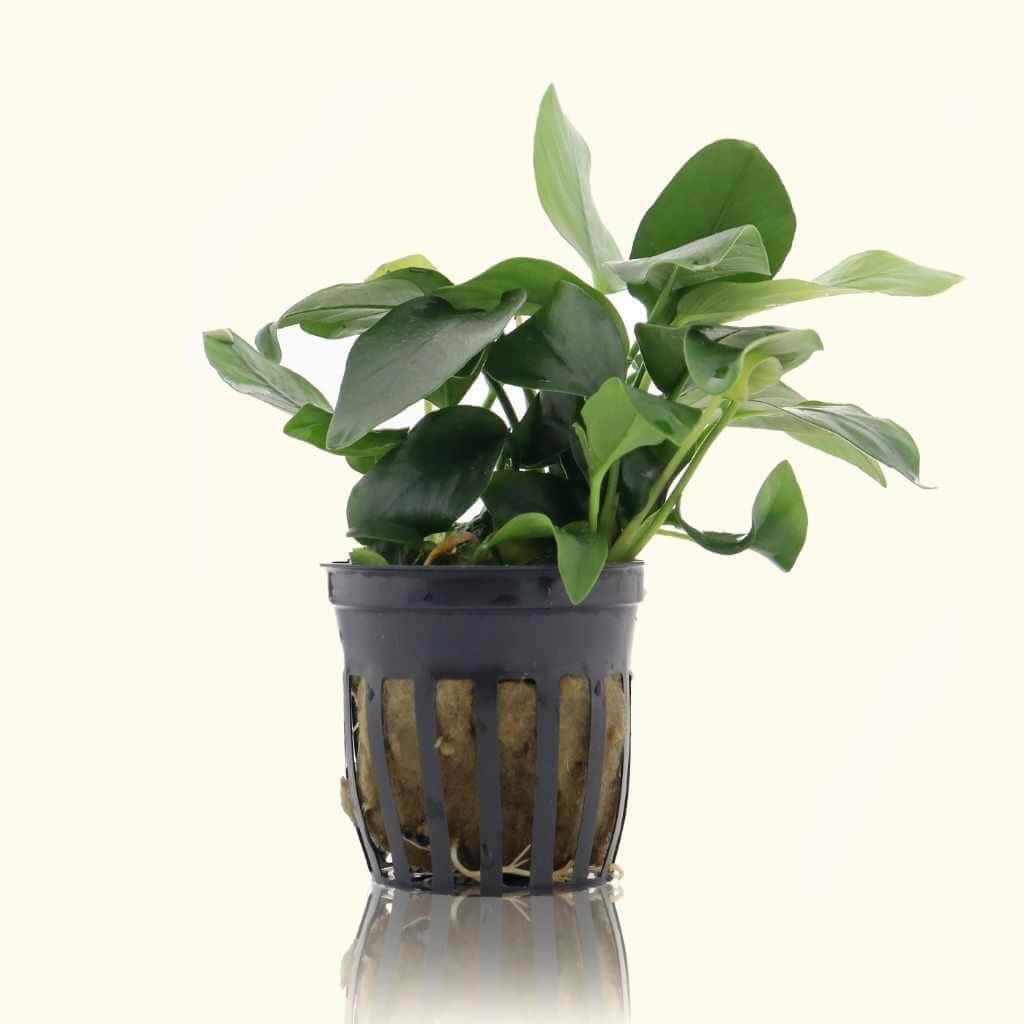
Anubias Nana is the single most recommended beginner aquarium plant globally – and the most forgiving anubias plant Qatar buyers can find in Doha.
It stays compact (5 to 10cm height), grows extremely slowly, and survives conditions that would kill most other aquatic plants. A new leaf every 3 to 4 weeks is normal. Do not interpret slow growth as a problem. This is what anubias nana care looks like in practice.
Light requirement: Very low. Anubias Nana grows under the basic LED strips that come packaged with starter aquariums. It does not need a quality planted tank light. In Qatar apartments with windows, keep it away from any direct or indirect sunlight – intense ambient light causes algae to colonise the slow-growing leaves faster than the plant can outgrow it.
Temperature: 22 to 28°C. Qatar’s AC-cooled rooms at 22 to 24°C sit comfortably within this range. No heater adjustment needed specifically for Anubias Nana in a Qatar setup.
pH: 6.0 to 8.0. Doha’s desalination tap water is slightly alkaline after conditioning – within range for Anubias Nana without any pH adjustment.
CO2: Not required. This is one of the definitive no CO2 plants for any Qatar aquarium.
Fertiliser: Optional but helpful. A weekly dose of liquid fertiliser after water changes improves leaf colour and growth rate. Without fertiliser, the plant survives but grows even more slowly and older leaves may yellow over time.
Browse Anubias Nana Potted Plant at World of Birds to see current stock.
Anubias Barteri Care Guide for Qatar Aquariums
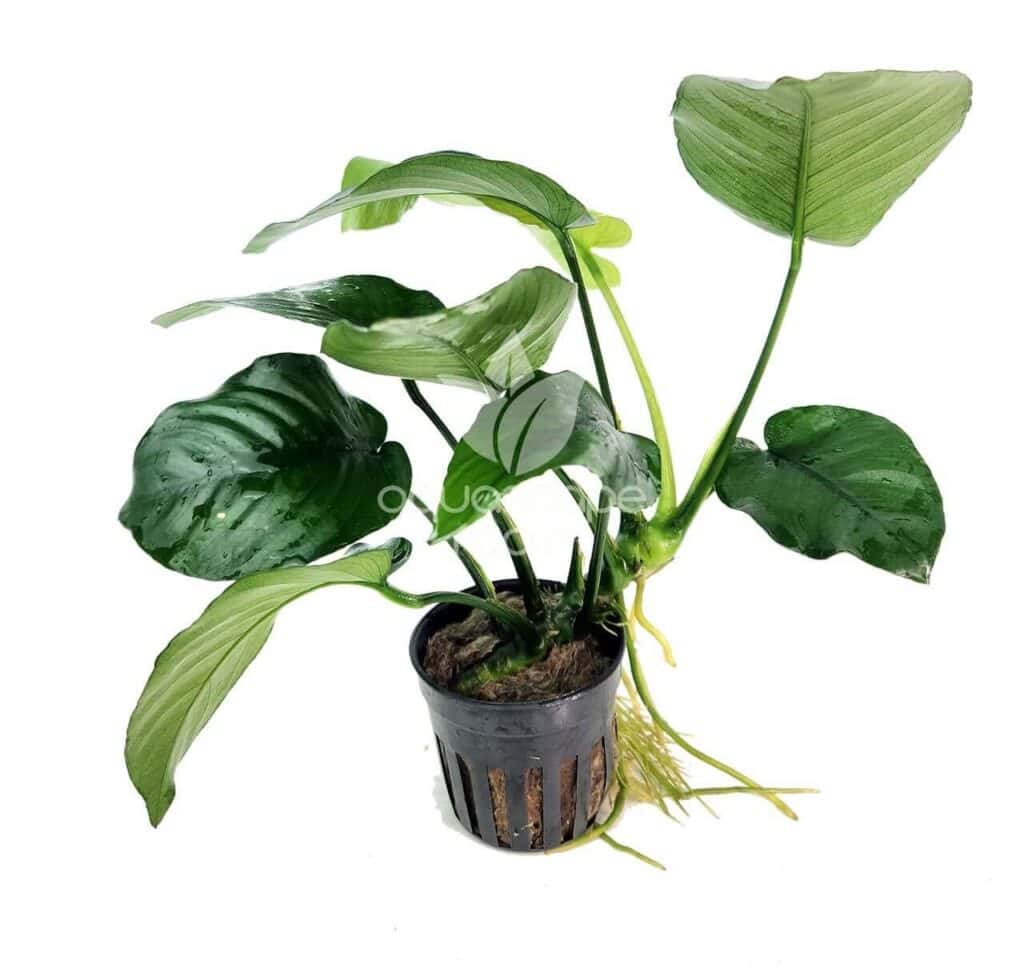
Anubias Barteri is the bold, larger-leafed Anubias variety – sometimes called Anubias broad leaf – that creates immediate visual impact in Qatar planted tanks. Where Anubias Nana adds detail and texture, Anubias Barteri adds presence.
Temperature: 22 to 28°C. Suits Qatar’s indoor conditions year-round.
pH: 6.0 to 8.0. Doha’s conditioned tap water works without adjustment.
Substrate: Not required – attach to driftwood or rock. Same rhizome rule applies: never bury.
CO2: Not required.
Fertiliser: Weekly liquid fertiliser improves Barteri’s growth rate more noticeably than on Nana. Barteri’s larger leaf surface area benefits from water-column nutrients – a consistent weekly dose produces new leaves every 2 to 3 weeks rather than every 3 to 4 weeks.
Browse Anubias Barteri Potted Plant at World of Birds to see current stock.
Anubias Lanceolata Care Guide for Qatar Aquariums
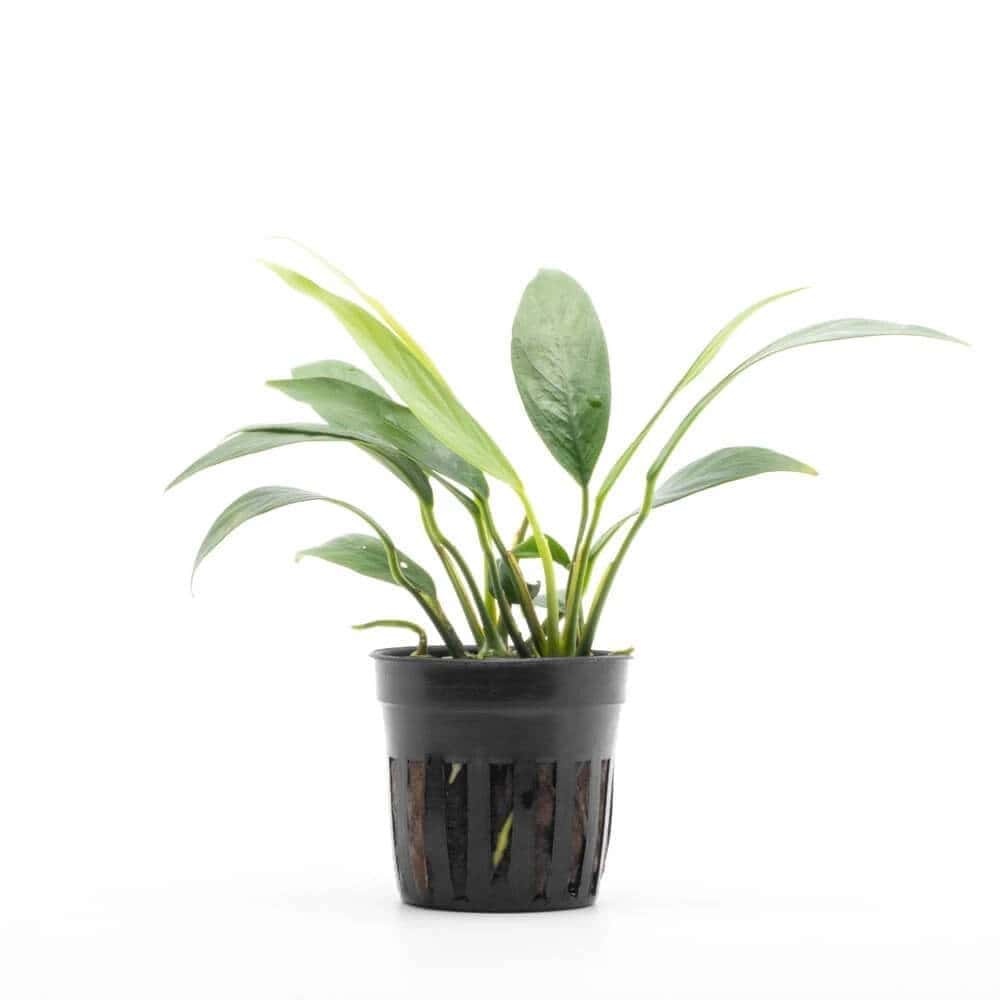
Anubias Lanceolata is the tall Anubias variety – immediately distinguishable from Nana and Barteri by its long, narrow lance-shaped leaves rather than the broad rounded or heart-shaped leaves of the other two.
Stems can reach 30 to 40cm, making it the only Anubias variety suited to background placement in taller Qatar aquariums. The narrow leaves create a very different visual texture from the anubias broad leaf varieties – lighter and more delicate while remaining slow-growing and indestructible under normal conditions.
Light requirement: Low to moderate. Same tolerance as Barteri.
Temperature: 22 to 28°C. Suits Qatar’s AC rooms without adjustment.
Placement: Mid to background. In a tall 75-litre Angelfish tank, Anubias Lanceolata attached to a large driftwood piece creates a natural Amazon river feel – the tall narrow leaves fill the midground zone that Angelfish swim through continuously. It suits Qatar buyers setting up Angelfish tanks who want plants that reach Angelfish swimming height without needing CO2 or specialist equipment.
Browse Anubias Lanceolata Potted Plant at World of Birds to see current stock.
Anubias Nana vs Anubias Barteri – Which Should You Choose for Your Qatar Aquarium?
Both are Anubias. Both follow identical care requirements. The choice comes down to tank size and placement zone.
Choose Anubias Nana if: your tank is under 40 litres, you want foreground coverage, or you want a small detailed anubias plant Qatar setup on a piece of driftwood without it dominating the midground. Nana stays compact indefinitely.
Anubias Barteri if: your tank is 40 litres or above, you want a bold midground anchor plant, or you want a single specimen that creates immediate visual impact.
Choose both if you can. A Qatar planted tank with Anubias Nana on small rocks in the foreground and Anubias Barteri on driftwood in the midground creates a layered, natural look that costs very little to set up and requires almost no maintenance once established.
The Golden Rule of Anubias Care – Never Bury the Rhizome
This is the single most important rule in this entire guide. More Qatar Anubias plants die from this one mistake than from any other cause.
The rhizome is the thick, horizontal green stem from which all Anubias leaves and roots grow. It must always be exposed to the water. It must never be buried in gravel, sand, or aquarium soil.
A customer at our Souq Al Ali store bought an Anubias Nana Potted Plant and planted the entire pot – rockwool, roots, and rhizome – directly into the gravel. Two weeks later they returned with a rotting plant asking what went wrong. The rhizome had been fully buried since day one.
The correct approach: attach the rhizome to hardscape (driftwood or rock) and allow the roots to anchor naturally. Or rest the rhizome on top of the substrate surface with the roots extending downward into the gravel. Either method works. Burying the rhizome does not. Browse aquascaping accessories at World of Birds for driftwood and hardscape options.
Should You Plant Anubias in Substrate or Attach to Hardscape?
Attach to hardscape. That is the correct answer.
Tie the rhizome to driftwood or a smooth rock using biodegradable cotton thread or fishing line. Tie it loosely – the goal is to hold the plant in position while the roots begin gripping the surface. Within 4 to 8 weeks, the roots anchor to the hardscape naturally. At that point, the thread can be left to decompose naturally or carefully cut and removed.
The alternative – resting the rhizome on the substrate surface with roots trailing into the gravel – works in bare or sand-bottom tanks where the rhizome is clearly exposed above the substrate line. Never press the rhizome into the gravel even slightly.
How to Attach Anubias to Driftwood and Rocks in Qatar
One of the most-searched practical questions about anubias plant Qatar keepers ask. Here is the process step by step:
- Remove from the pot. Take the Anubias out of its plastic pot. Remove the rockwool from around the roots gently – rockwool is used for transport and does not belong in the aquarium.
- Choose your hardscape. Select a piece of driftwood or smooth aquarium-safe rock at an appropriate scale for the plant variety. Anubias Nana suits smaller, detailed driftwood. Anubias Barteri and Lanceolata suit larger, more substantial pieces. WOB’s pre-treated driftwood at Souq Al Ali is safe to add directly to your tank without boiling or extended soaking.
- Position and tie. Press the rhizome flat against the hardscape surface. Tie it in place with biodegradable cotton thread or thin fishing line passed around the rhizome and hardscape two to three times.
- Position in the tank. Place the hardscape piece with the attached Anubias in the tank. Roots should face downward toward the substrate. The rhizome must be fully visible above the hardscape surface or attachment point.
- Leave it alone. Within 4 to 8 weeks, the roots grip the hardscape surface. The thread either dissolves naturally (if cotton) or can be carefully removed once the plant is anchored securely.
Browse driftwood and aquascaping accessories at World of Birds to find the right hardscape for your Anubias setup.
Amazon Sword Plant Care Guide for Qatar Aquariums
Amazon Sword (Echinodorus species) is the definitive background plant for Qatar beginner planted tanks. It is South American – native to the rivers and lakes of the Amazon Basin – which makes it the natural companion to Angelfish and other Amazon-origin fish commonly kept in Qatar aquariums.
A mature Amazon Sword reaches 30 to 50cm in height. A single plant fills the back of a 40-litre tank completely with broad, lance-shaped green leaves that create a lush background without requiring CO2 or specialist lighting. It is one of the best low light aquarium plants for a Qatar beginner setup alongside Anubias.
Light requirement: Moderate. A standard quality aquarium LED running 8 to 10 hours daily suits Amazon Sword well. It grows under lower light than this but produces fewer leaves and grows more slowly.
Temperature: 22 to 28°C. Qatar’s AC-cooled rooms at 22 to 24°C suit Amazon Sword comfortably.
pH: 6.5 to 7.5. Doha’s conditioned tap water falls within this range in most setups.
Browse live aquatic plants available in Qatar to check current Amazon Sword stock at World of Birds.
Do Anubias and Amazon Sword Need CO2 in Qatar?
No. Neither plant requires CO2 injection.
This is the most commonly asked question about both species, and the answer is the same for both in a Qatar aquarium context.
CO2 injection accelerates growth and improves colour intensity in some demanding stem plants. For Anubias and Amazon Sword, the growth rate improvement from CO2 is modest – and the cost and complexity of a pressurised CO2 system (regulator, cylinder, diffuser, bubble counter) is significant.
All three anubias plant Qatar varieties grow reliably under standard LED lighting with no CO2 in Qatar home aquariums. Amazon Sword grows without CO2 provided it has root tabs in the substrate. These are not plants that suffer meaningfully from the absence of CO2 – they evolved without it.
Fertiliser for Anubias and Amazon Sword – No CO2 Plants That Benefit from Weekly Feeding
Two types of fertiliser matter for Qatar planted tanks using these species.
Liquid fertiliser feeds water-column absorbers like all Anubias varieties. Add a small dose weekly, immediately after each water change. The best liquid fertilisers for Anubias contain iron (for deep green leaf colour), potassium (for cell health), and trace minerals.
Root tabs feed substrate-feeding plants like Amazon Sword. Push a root tab into the gravel directly beneath the root zone at planting time. Replace every 2 to 3 months.
Browse plant fertilisers and food at World of Birds for liquid fertiliser and root tab options available in Doha.
Common Problems with Anubias Plants in Qatar – and How to Fix Them
Yellow Leaves on Anubias – What Causes It?
Yellow leaves on anubias plant Qatar tanks are almost always caused by one of three things.
- Nutrient deficiency is the most common cause. In tanks without any liquid fertiliser, Anubias slowly depletes available trace minerals from the water over months.
- Partially buried rhizome causes yellowing alongside darkening and softening of the leaf bases.
- Insufficient light causes slow fading of leaf colour over months rather than sudden yellowing.
Algae on Anubias Leaves – The Qatar Window Problem
Anubias grows slowly. The same leaf surface stays on the plant for months. This gives algae time to colonise leaves that faster-growing plants would have shed weeks ago. Black beard algae appears as dark tufts along leaf edges and veins. Caused by low CO2 and stagnant water near the plant.
Green spot algae appears as small hard green circles on the leaf surface. Caused by too much light and not enough phosphate.
Brown or Rotting Leaves – The Buried Rhizome Problem
Dark, soft, collapsing leaves that detach easily from the rhizome indicate rhizome rot from burial. This cannot be reversed if the rhizome has rotted through – the plant is dead.
If caught early (leaves darkening but the rhizome is still firm when pressed), remove the plant from the substrate immediately, trim all affected leaves at the base, and reattach the rhizome to hardscape.
No New Growth – Patience or Problem?
One new leaf every 3 to 4 weeks is normal anubias nana care growth pace. No new growth for 6 to 8 weeks indicates a problem: no fertiliser in a long-running tank, partially buried rhizome causing stress, or insufficient light (under 4 hours daily).
Can Anubias and Amazon Sword Live Together in the Same Qatar Aquarium?
Yes – and this combination is the most practical planted tank approach for beginner aquarium plants Qatar buyers. They occupy different tank zones without competing. Amazon Sword fills the background with tall, broad leaves. Anubias covers the midground and foreground on driftwood and rocks. Neither competes with the other for nutrients – Amazon Sword feeds from the substrate roots, Anubias feeds from the water column. They draw on different nutrient sources simultaneously.
For a complete step-by-step setup guide using both species, read our planted aquarium guide for Qatar.
What Fish Can Live With Anubias and Amazon Sword Plants in Qatar?
Both plants suit a wide range of community fish. Neither is fragile, neither gets eaten by most commonly available Qatar fish, and both improve water quality in ways that benefit the fish sharing their tank. Unlike java fern Qatar keepers sometimes pair with cichlids, Anubias and Amazon Sword work safely with the broadest range of Qatar fish species.
Fish that work well with Anubias and Amazon Sword in Qatar:
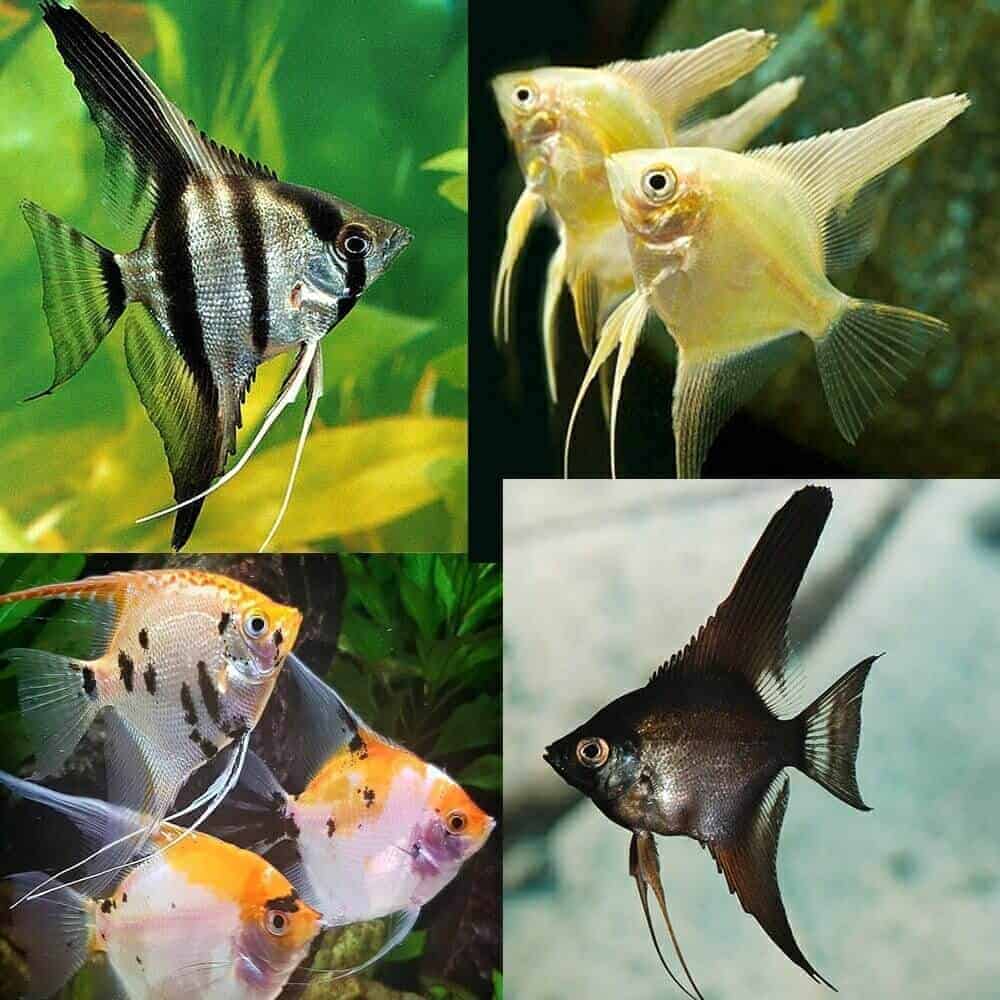
- Angelfish – the natural pairing. Angelfish love the broad leaves of Amazon Sword for spawning and use Anubias Barteri as territorial cover. For the full setup, read our Angelfish care guide for Qatar.
- Guppies – peaceful, their waste provides a natural slow-release fertiliser for Anubias through the water column.
- Corydoras Catfish – bottom dwellers that clean substrate without disturbing Amazon Sword roots.
- Betta Fish – Anubias Nana on a small piece of driftwood is the perfect Betta tank plant. Low light, no CO2, creates cover and resting spots. Read our Betta Fish care guide for Qatar.
- Zebra Danios – active schooling fish that do not damage plants.
Fish to avoid:
- Goldfish – eat Amazon Sword leaves and dig substrate, uprooting the root system within days.
- Silver Dollar fish – herbivores that strip all plant leaves completely.
- Large digging Cichlids – uproot Amazon Sword by excavating the substrate around the roots.
Browse freshwater fish available at World of Birds to see which compatible species are currently in stock.
Where to Buy Anubias and Amazon Sword Plants in Qatar – World of Birds, Souq Al Ali
World of Birds has been stocking live aquarium plants in Qatar since 1985. Our Souq Al Ali store carries Anubias Nana, Anubias Barteri, and Anubias Lanceolata as potted plants, along with Amazon Sword and a rotating selection of other live aquatic plants based on each shipment.
Every item needed for a Qatar planted tank setup is available in one visit: anubias plant Qatar varieties, Amazon Sword, aquarium tanks, driftwood, aquascaping accessories, liquid fertiliser, root tabs, water conditioner, and compatible freshwater fish.
Browse our live plants collection online to see current stock. Visit us at Qatar’s oldest pet and aquatic store, open since 1985. Find us on Google Maps.
Frequently Asked Questions About Anubias and Amazon Sword Plants in Qatar
How do you care for Anubias Nana in Qatar?
Anubias nana care in Qatar requires low light (6 to 8 hours daily), no CO2, no substrate burial of the rhizome, and optional weekly liquid fertiliser. Attach to driftwood or rock with cotton thread. In Qatar’s AC-cooled rooms at 22 to 24°C, Anubias Nana grows slowly but consistently year-round without specialist equipment. All three Anubias varieties are in stock at World of Birds, Souq Al Ali.
Should Anubias be planted in substrate or attached to hardscape?
Always attach to hardscape. The rhizome – the thick horizontal stem Anubias grows from – rots within 2 to 3 weeks if buried in gravel or soil. Tie the plant to driftwood or a smooth rock with cotton thread. The roots anchor naturally within 4 to 8 weeks. This is the most important single rule for any anubias plant Qatar keeper needs to follow.
Does Amazon Sword need CO2 in Qatar?
No. Amazon sword plant care in Qatar does not require CO2 injection. Amazon Sword grows under standard LED lighting without CO2 provided it has root tabs placed in the substrate beneath its roots. Without root tabs in plain gravel, growth slows significantly after 2 to 3 months as nutrients deplete. Weekly liquid fertiliser helps both Amazon Sword and Anubias maintain healthy growth.
Why are my Anubias leaves turning yellow in Qatar?
Yellow Anubias leaves in Qatar tanks are almost always caused by nutrient deficiency in tanks without liquid fertiliser. Add a weekly dose of liquid fertiliser after each water change. If leaves are also darkening and collapsing at the base, the rhizome may be partially buried – reattach to hardscape immediately. New growth appears green within 2 to 3 weeks of correct care.
Where can I buy Anubias plants in Qatar?
World of Birds at Souq Al Ali, Doha stocks Anubias Nana, Anubias Barteri, and Anubias Lanceolata as potted plants, along with Amazon Sword and other beginner aquarium plants Qatar hobbyists need. We have been stocking live plants in Qatar since 1985. Contact us on WhatsApp at 33311542 to check current availability before visiting.
Ready to Plant Your Qatar Aquarium? Visit World of Birds Today
Anubias and Amazon Sword are the most practical combination of low light aquarium plants available in Qatar. No CO2. No specialist substrate. No demanding lighting schedule. Just reliable, beautiful plants that grow in Qatar’s conditioned tap water and AC-cooled home environments.
All three Anubias varieties and Amazon Sword are available at World of Birds, Souq Al Ali – along with the driftwood, fertiliser, and fish to complete your planted tank in one visit.
Browse our live plants collection available now in Qatar, or message us on WhatsApp at 33311542 to check current plant stock before visiting.
